
The Problem with Intentional Intergenerational Worship Today: Why Nostalgia Won’t Grow Your Church
And why "blended worship" as a solution is largely the problem ...

If you’re looking for a warm affirmation of how things used to be, this article (it’s too long to call a blog) probably isn’t it. What follows is reality, and reality has a habit of stepping on the toes of anyone still hoping the church culture of yesterday might magically return. Just so we’re clear … nostalgia isn’t the problem: The refusal to face reality is.
The Intergenerational Ideal We Keep Romanticizing
Pastors get told a simple story. The “healthy” church has babies, teens, parents, and seniors all in the same room, singing the same songs, loving the same service. Grandparents beam. Parents relax. Kids sit quietly and soak up faith by osmosis while “learning how to worship.” That picture gets held up as the gold standard of church life.
There is only one problem. That picture is mostly a memory.
The whole idea of intergenerational worship sounds noble, but the facts just don’t line up with the nostalgia. Intergenerational worship wasn’t the result of some brilliant strategy. It happened because families stayed put. Generations lived in the same town, worked in the same businesses, farmed the same land, and attended the same church. You did not go searching for a congregation that matched your preferences. You went where your family went. The church felt intergenerational because the community itself was intergenerational.
Fast forward to now. Families scatter. Kids move for school, work, and relationships. Grandkids grow up in different cities, sometimes in different countries. The neighborhood around many churches has flipped two or three times. Your average street holds multiple worldviews and very little shared religious story. Inside the walls, you still have people who remember “how it used to be,” and they keep waiting for that world to return. It will not.
That gap between memory and reality drives a lot of bad worship decisions. Leaders keep chasing an ideal that grew out of a culture we no longer live in. They try to build services that “bring everyone together,” and the results usually serve one group very well: the people who already understand church and already know the script.
Since worship still functions as the front door for most congregations, it is time to reckon with the culture that made intergenerational worship possible in the first place, and why that culture has disappeared.
The Culture That Made Intergenerational Worship Possible Is Gone
Intergenerational worship didn’t happen because churches were brilliantly designed. It happened because the culture handed it to us on a silver platter. Families stayed put. Kids grew up in the same town, on the same land, in the same house. And when they became adults, most of them didn’t go far. Even if they left for a bit, they usually circled back to raise their own kids on familiar ground. Stability wasn’t a gift. It was the default setting.
And in that world, everybody was “Christian.” Not committed. Not discipled. Just culturally Christian. It was the air the country breathed. Whether you went to church or not, you still checked the “Christian” box because that’s what everyone did. In 1954, church participation hit its all time high. Churches grew because families grew. Simple as that. You didn’t reach people. You inherited them.
That model collapsed.
The cracks showed up in the 1960s when the Boomers started bailing on the churches of their parents and grandparents. The trust in institutions evaporated. Media stopped protecting the national myth and started showing the ugly stuff. Television brought war into the living room. Leaders got exposed. Hypocrisy went public. And the church got hit with the same blunt force trauma.
The cultural support beams that held even the weakest church upright rotted out. The predictable religious world most pastors assume still exists started disappearing under their feet.
Sure, most Americans still call themselves Christian, but that label doesn’t mean much now. Commitment is thin. Attendance is thinner. David T. Olson in his book The American Church in Crisis: Groundbreaking Research Based on a National Database of Over 200,000 Churches pointed out years ago that under 15 percent of Americans show up for worship on any given weekend. That number alone should shake us awake – and those numbers haven’t improved since his book was published. The Judeo Christian storyline that used to shape the whole country doesn’t hold the center anymore.
And while all that was breaking down, the ground shifted again. Families started moving. Kids and grandkids stopped settling in the same community. Neighborhoods flipped faster than congregations could keep up. A church could live on a corner for 80 years and still lose touch with its own street. The idea that three or four generations will stack up in the same pews just because you’re there is wishful thinking.
That brings us to where we are now, with insiders and outsiders living in two totally different worlds, and worship assumptions that simply don’t work anymore.
Insiders, Outsiders, and the New Church Landscape Today
Once the cultural floor gave out, it became painfully obvious that we weren’t all living in the same religious world anymore. Inside the church, you’ve basically got two groups. A small number are “Disciples.” They’re actually trying to line their lives up with Jesus and the New Testament. They’re not perfect, but at least they’re aiming in the right direction.
Then you have the “Church Members.” This is the big group. They believe. They care. They show up. But the gravitational pull of the culture shapes them far more than the Sermon on the Mount does. Membership has its privileges, after all. Their expectations for worship, programs, mission, and ministry lean toward personal benefit, not disciple making. They are sincere, but sincerity doesn’t equal maturity.
Outside the church, the divide is even bigger. A shrinking number have meaningful church experience. Some are Dones. They quit because they were tired, frustrated, wounded, or just worn out. Some are Uhms. They drifted without a clear reason. Life got busy. Faith got sidelined. And then there are the Nones. They have little to no Christian background, and in many cases, no interest. Paul would’ve called the whole group Outsiders. The church folks are the Insiders.
Here’s the reality pastors hate to admit. Insiders walk into almost any worship setting and know exactly what to do. Outsiders don’t. Insiders know the vocabulary, the music, the pacing, the expectations. Outsiders know nothing. They don’t know why we stand up, sit down, sing, bow our heads, pass plates, read scriptures, or listen to a twenty minute sermon. And blended worship, the supposed cure for generational tension, is the worst possible environment for them.
It tries to please everyone in the congregation, which means it’s built for people who already understand church. Outsiders walk in and feel like they crashed a family reunion where everyone shares a history they’ve never lived. The divide isn’t small. It’s massive. and pretending otherwise hasn’t helped a single congregation grow.
The next step is to get honest about where intergenerational churches still show up today, and why those exceptions exist.
Where Intergenerational Churches Still Exist Today, and Why
You can still find intergenerational churches in North America, but not because they cracked some secret code. They exist for very specific reasons, and none of them have anything to do with blended worship brilliance or committee crafted compromise. In fact, the church I currently attend is a perfect example. It’s a young-family-focused church plant. The worship style, the sermon content, the energy level, the whole thing is obviously built for Millennials and Gen Z parents. Yet every week a handful of Boomers and Gen Xers faithfully show up, fully committed, fully supportive, and fully aware they’re not the target audience. From the outside, it looks intergenerational. Anyone paying attention knows better. The mix isn’t intentional. It’s incidental.
There are three particular circumstances where you’ll find intergenerational churches that seem to be working.
First, churches with over a hundred in worship tend to look intergenerational – the church I mentioned above is a good example. The larger the attendance, the more outliers you pick up from different age groups. A church targeting young families will still attract a handful of committed Boomers or Gen Xers who like the mission, the pastor, or just don’t want to leave. A church aimed at older adults might still gather a few younger folks who appreciate stability. But let’s be clear. The generational mix is a byproduct of size. Not intentional design.
Second, rural congregations often remain intergenerational because they have no other choice. When a town has one or maybe two churches within twenty miles, everyone ends up in the same sanctuary. If you want Christian community, you go where the community goes. Nobody is curating multiple worship styles. Nobody is running a focus group. Availability is the deciding factor.
Third, there are still pockets in this country where families stay rooted on purpose. Family farms. Family businesses. Land that gets passed down instead of sold off. In those communities, three or four generations really do sit in the same pews because they still live within shouting distance of each other. Stability is baked into the soil.
What all these examples have in common is simple. The intergenerational mix shows up by circumstance, not strategy. These churches aren’t pulling off some miraculous worship balancing act. They’re reflecting the demographic dynamic of the community around them. And in most places across the country, those demographics and those dynamics don’t exist anymore.
The moment a church tries to manufacture intergenerational worship on purpose, it runs straight into a wall that blended worship simply can’t fix.
The Blended Worship Problem and Why It Fails Outsiders
This is where most churches get stuck. They see the generational spread they wish they had, they remember the generational spread they used to have, and they try to force it back into existence with one familiar tool. A blended worship service. The theory goes something like this. If you pack enough musical styles, liturgical elements, and generational preferences into one hour, everyone will find something they love.
Except that’s not how people actually experience worship.
The blended worship defenders like to compare it to a buffet. “There’s something for everyone,” they say. But a real buffet lets you pick what you want and skip what you don’t. Blended worship isn’t a buffet. It’s a plate piled high with every dish in the building, and you’re expected to choke it all down whether you like it or not. Nobody leaves satisfied. They leave full of things they didn’t choose.
And music is only the beginning. One generation wants the organ. Another wants the guitar. Another doesn’t care as long as it’s loud enough to feel. But then you hit the rest of the service. Some want formal. Some want casual. Some want predictable. Some want spontaneous. Some want a twenty minute exegetical sermon. Others want five crisp minutes and a story. Some want screens. Others think screens are a sign that the end is near.
You can’t please all of that. You can barely please adjacent generations. Try to splice three or four together and you end up with a service that doesn’t inspire anybody. At best, people tolerate the parts that don’t speak to them. At worst, they resent them. And the visitors, especially those with little or no church background, have no idea what’s happening or why it matters. Blended worship might soothe a few anxious insiders, but it doesn’t reach anyone new.
And that’s the real problem. Pastors keep hoping blended worship will hold the generations together, but it rarely reaches anyone outside the church. A service built to appease everyone ends up centering the very people who already attend, and it does nothing to engage the people the church claims it wants to reach. That’s not strategy. That’s survival mode dressed up as hospitality.
But if blended worship is this ineffective, what about the people who walk in with no church memory at all? What does this feel like to them?
Why Outsiders Struggle Most in Intentionally Intergenerational Services
If insiders walk into blended worship and grumble a little, outsiders walk in and wonder what planet they just landed on. It’s not that they’re offended. They’re lost. And lost people don’t stay long.
Insiders have muscle memory. They’ve been standing and sitting and singing and pretending to know the third verse of every hymn since childhood. They know the cues. They know the vocabulary. They can smell a sermon outline coming from a mile away. It’s familiar territory.
Outsiders? They don’t have a clue. I’ve watched it more times than I can count. One man told me after visiting a traditional service that the responsive reading scared him. He said it felt like he’d stumbled into a brainwashed cult chanting a mantra. And he wasn’t being sarcastic. He was genuinely freaked out. Meanwhile, the insiders around him were reciting the words with all the emotion of reading a grocery list. They never noticed how bizarre the whole thing looked to someone who had never seen it before.
That’s the reality we keep ignoring. Blended worship might look “balanced” to insiders. Outsiders see a mashup of church traditions that don’t make sense together. It’s like flipping channels with a remote that’s stuck on fast forward. You catch a scene, but you don’t know the storyline, the characters, or the point. You sit politely. You nod at the expected times. But you’re not connecting with anything.
And we wonder why they don’t come back.
They’re not rejecting Jesus. They’re not rejecting Scripture. They’re not rejecting community. They’re rejecting a worship experience written for people who already know the script. A pastor once told me, “They’ll grow into it.” No, they won’t. They’re not staying long enough to grow into anything. They’re walking out thinking, “Nice people, but I have no idea what that was.”
When worship tries to speak every generational dialect at once, it ends up speaking none of them well. And the people who feel the disconnect the sharpest aren’t the insiders. It’s the ones we say we want to reach.
I’ll be honest. The longer I’ve watched this play out, the more convinced I am that we’re asking the wrong question. It’s not, “How do we get every generation in the same room?” The real question is, “Why do we keep assuming that’s even the right goal?” And that becomes painfully obvious when we talk about how kids fit into the picture.
Kids in Worship: The Family Worship Myth and the Kid Engagement Problem
Some churches try to hold intergenerational worship together by sheer force of will. “We’ll put everyone in the same room,” they say. “Adults, youth, kids. That’s how families grow in faith.” It sounds noble. It sounds biblical. It also sounds like the kind of thing someone says who hasn’t actually watched what happens in the pews.
I have. Week after week.
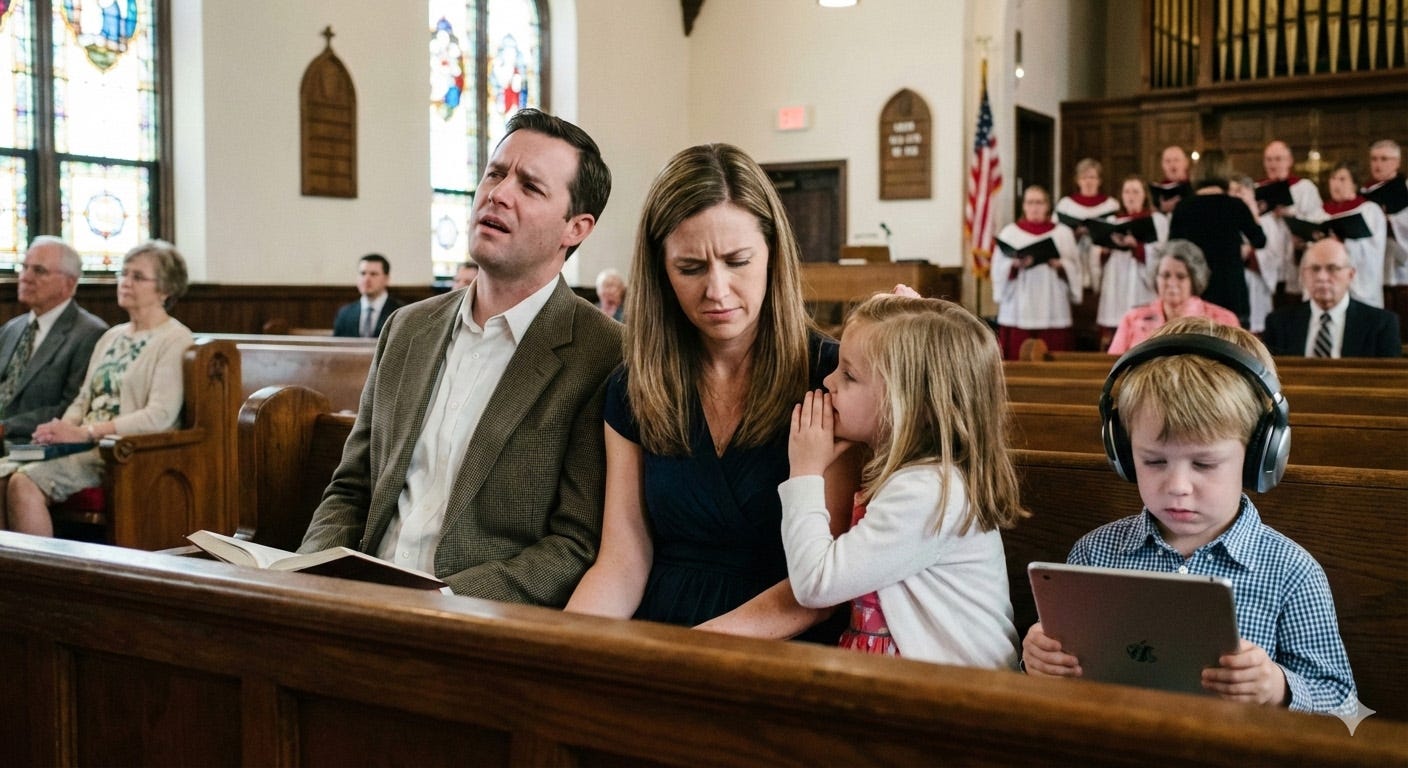
The parents with young kids aren’t soaking in the sermon. They’re whispering negotiating with a four-year-old who has the attention span of a caffeinated squirrel. In today’s world, most parents eventually give up and hand the child a phone or an iPad. Earbuds go in. The kid disappears into a cartoon universe. The rest of the parents tag team so at least one adult hears part of the message. And everyone walks out feeling a little guilty and a lot exhausted.
Meanwhile, the church congratulates itself for being “family friendly.”
But let’s just say the quiet part out loud. If the kids are checked out on screens and the parents are mentally running a zone defense, nobody is engaging worship. Nobody is being discipled. Nobody is having a meaningful encounter with God. It’s childcare with hymns.
And here’s the kicker. Even with all the effort to keep kids in the room, the majority of church raised children walk away from the church as teenagers or young adults. So clearly the “they’ll get used to it” strategy isn’t working. Sitting in the sanctuary doesn’t make disciples any more than sitting in a garage makes you a mechanic. (Still think kids belong in adult worship? Check out the statistics in the book Already Gone: Why Your Kids Will Quit Church and What You Can Do About It by Ken Ham – I don’t agree with his conclusions and solutions, but his research is statistically stellar.)
Churches cling to this model because it feels nostalgic. It reminds them of a world where families stuck together, communities stayed stable, and the church could rely on biology to fill the pews. But that world is gone. And clinging to the worship patterns of a vanished era won’t resurrect it. (More about why kids don’t belong in adult worship.)
Here’s where this all comes to a head. If worship is going to be the front door for people who aren’t disciples yet, then it has to be designed for the people we’re trying to reach, not the people we’re afraid of upsetting. Let’s look at what that means for churches that actually want to make disciples instead of managing preferences.
The Mission Reality Check for Churches Trying to Reach New People
This is where everything comes into focus. Churches keep trying to build worship services that hold every generation together, but they’re not actually asking the most important question. They’re asking, “How do we keep everyone happy?” when they should be asking, “Who are we trying to reach?”
Those two questions never lead to the same outcome.
If worship is going to be the front door of the church, then it has to be built for the people on the outside of the door, not the people already sitting inside. But in most congregations, worship gets engineered to protect comfort, preserve memories, and avoid upsetting the regulars. That’s how you end up with blended worship. That’s how you end up with frustrated leaders. And that’s how you end up with visitors who come once, nod politely, and disappear forever.
Trying to reach “everyone” isn’t noble. It’s evasive. And it guarantees one thing. You’ll keep reaching the people you already have and almost no one else. That’s not outreach. That’s maintenance with a soundtrack.
Every pastor says they want to make disciples. Great. Then the worship service has to speak in a voice the unchurched can actually hear. It has to reflect the learning style, the values, the questions, and the cultural instincts of the people the church claims it wants to reach. Anything less is wishful thinking wrapped in nostalgia.
This is the point where leaders either get serious or keep spinning in circles. Because the only way forward for a church that actually wants to reach people it’s not currently reaching is to name its target. Not in theory. Not in a vague “we welcome everyone” sentence. A real target. A real generation. A real audience.
That’s where we’re going next.
The Strategic Solution: Choose a Target Generation
Once you admit that trying to reach everyone only guarantees you’ll keep reaching the same insiders you already have, the next step becomes obvious. You have to choose a target generation. Not theoretically. Not “in spirit.” Actually choose one. That single act separates churches that grow from churches that drift.
Before someone clutches their theology pearls, let’s name what almost no one is willing to say out loud. God had a target audience. He chose the Hebrews, not because they were the biggest or the best, but because they were the people through whom he planned to shine a light to everyone else. The mission was global, but the method was targeted. Jesus followed the same pattern. His own words were “I was sent only to the lost sheep of Israel.” That’s a target audience. Yes, he healed the Roman centurion’s servant. Yes, he engaged Samaritans and Gentiles all over the region. He didn’t turn anyone away. But he never confused compassion with strategy. Paul did the same thing. He’d stop in the synagogue to take the temperature, but he always ended up with the Gentiles because that was the assignment God handed him. In other words, the greatest disciple makers in Scripture weren’t guessing who they were talking to. They knew.
And if they knew, then pastors and churches today don’t get a pass.
This is where the excuses start flying. “But we love everyone.” Great. Love everyone. But speak to someone. Because when you try to preach and sing and structure worship for four different generations at once, you end up speaking in mush. No edge. No resonance. No clarity. And clarity is what opens the door for someone far from God to actually hear the gospel.
I’ve worked with churches that finally got brave enough to choose a target generation, and the shift was instant. They stopped apologizing for not being everything to everybody. They stopped designing worship out of fear. They stopped bending themselves into a theological pretzel trying to hold competing expectations together. And the irony is that once they focused on one generation and one specific demographic, they actually became more welcoming to others. Why? Because a church with a clear voice is easier for outsiders to trust.
The churches that refuse to choose? They keep hoping blended worship will magically solve the tension. It won’t. You can’t build momentum on compromise. And you can’t disciple imaginary people. You can only disciple actual people, in actual time, with actual needs, and that means speaking directly to a particular generation.
Here’s the payoff. When a church chooses a target, intergenerational participation doesn’t vanish. It shows up on its own. It shows up by serendipity. It shows up because people of all ages can smell authenticity from a mile away. What disappears is the exhausting, ineffective, anxiety-ridden attempt to engineer a service that satisfies everyone and transforms no one.
Now let me wrap this up by naming what a church has to do if it actually wants to reach people it’s not reaching yet. That final step is where clarity becomes conviction.
Moving Forward on Purpose
This is the moment where pastors have to decide if they’re going to keep chasing a world that no longer exists or start leading a church that actually has a future. Because the truth is painfully simple. You can’t keep designing worship for the people you already have and expect to reach people you’ve never reached.
Clarity isn’t cruel. It’s faithful.
A church that chooses a target generation isn’t excluding anyone. It’s speaking with intention. It’s building worship that actually connects. It’s preaching in a voice that makes sense to the outsider instead of recycling the comfortable habits of the insider. And it’s doing all of that without apology, because disciple making requires focus, not sentiment.
When a church gets serious about this, everything gets cleaner. The worship team stops fighting battles they can’t win. The pastor stops preaching sermons aimed at four different learning styles. The leadership stops wasting energy trying to please people who haven’t been happy in twenty years. And the congregation starts noticing that visitors aren’t blinking in confusion anymore. They’re leaning in. They’re engaging. They’re returning.
That’s what happens when a church finally speaks with a single voice.
Intergenerational worship isn’t achieved by blending everything together. It happens when a church is so clear about its mission, so focused on its audience, and so committed to making disciples that people across generations show up because they’re drawn to the life of the church, not the style of the service. That’s serendipity, not strategy. And it’s far more sustainable than any blended model ever invented.
The churches that will grow in the next decade won’t be the ones trying to resurrect 1954. They’ll be the ones bold enough to choose who they’re trying to reach and build worship that actually speaks to them. The path forward isn’t complicated. It’s just costly. You give up nostalgia to gain mission. You trade comfort for clarity. You stop managing preferences and start making disciples.
That’s the doorway into actual growth. And it’s wide open for any church willing to walk through it.